


 VietNam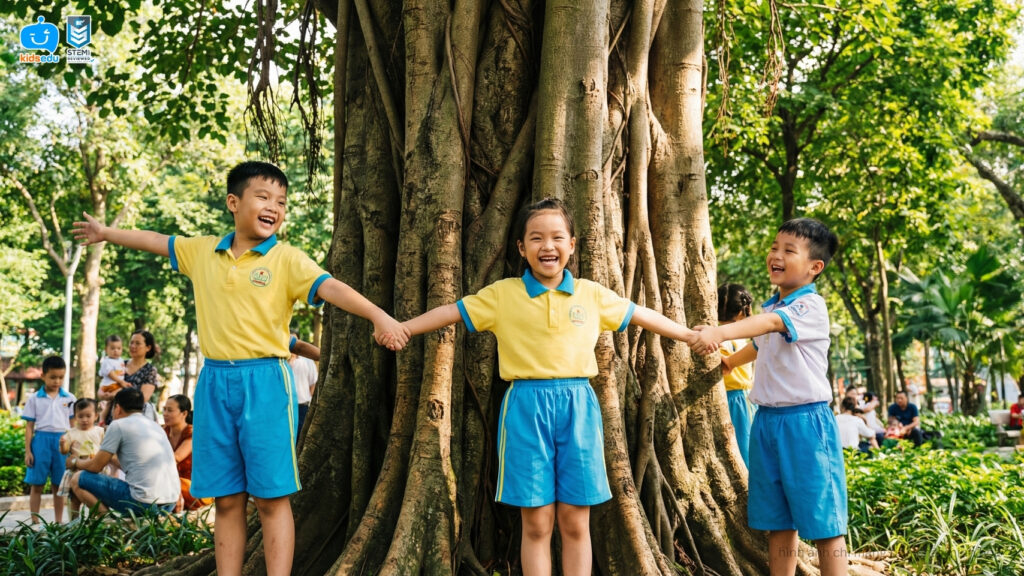
Transforming the Great Outdoors into a Dynamic Math Lab
1. Why Nature is the Ultimate Living Math Manipulative
It isn’t just about fresh air; it’s about sensory-rich engagement. Nature provides an endless supply of authentic materials—leaves, pebbles, and twigs—that empower preschoolers to grasp spatial concepts and measurement through physical interaction rather than static worksheets.
It is through this tactile exploration that children truly decode the world of numbers. According to Jean Piaget’s theory of cognitive development, preschoolers navigate the Preoperational and Concrete Operational stages. They cannot internalize abstract numbers without first “touching” them. By leveraging branches and stones as living math entities, the young brain deconstructs logical rules with far greater ease.
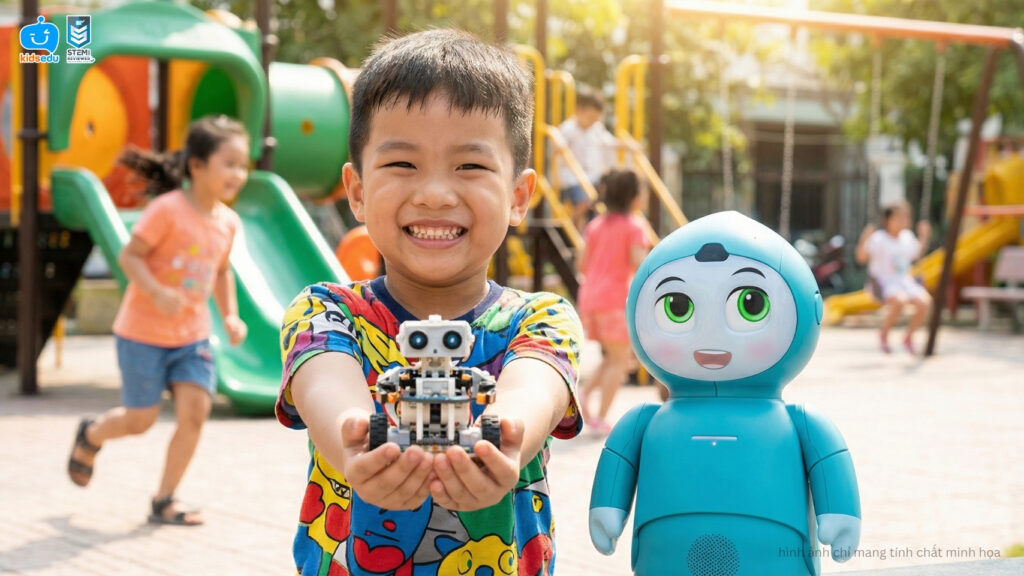
This approach aligns with the National Association for the Education of Young Children (NAEYC), which asserts, “The outdoor environment offers an expansive learning canvas where children freely explore core mathematical concepts like geometry and measurement through physical interaction.”
2.3 High-Impact Outdoor Math Activities
Ready to turn your next walk into a learning adventure? These three activities—core components of the KidsEdu STEM curriculum—are designed for immediate application.
2.1. The “Treasure Step” Challenge
Pick two landmarks, such as two oak trees, and challenge the child: “How many steps do you think it takes to reach that tree?” By counting their own strides and comparing them with an adult’s, children move beyond simple counting to understand relative distance and estimation.
2.2. Logic Sorting & Pattern Recognition
Gather various natural elements and ask the child to create a logical sequence (e.g., 1 leaf – 2 stones – 1 leaf). This simple exercise triggers early Computational Thinking, laying the groundwork for future coding and scientific logic.
2.3. Achieving Equilibrium with Nature’s Tools
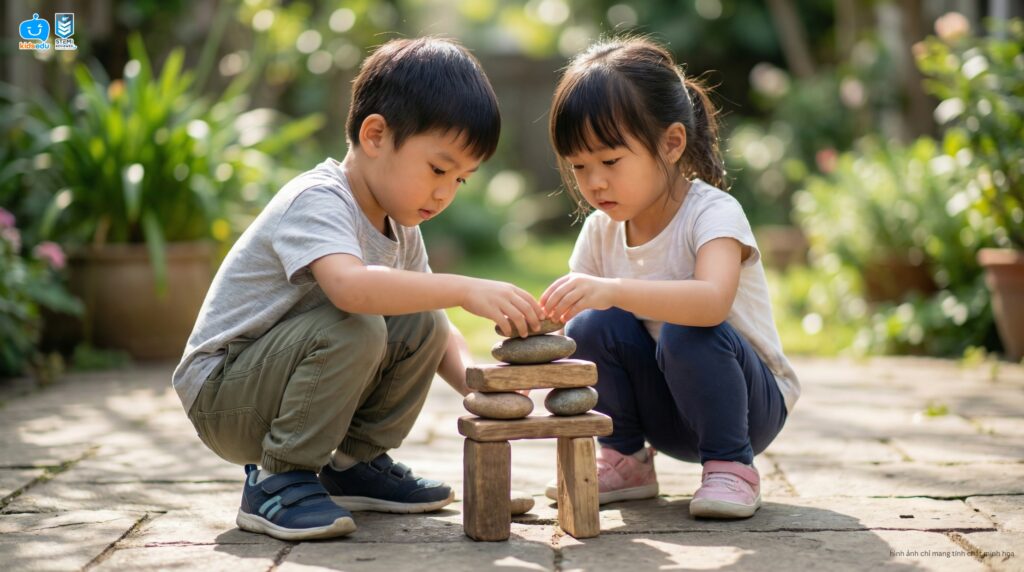
Nature is a ready-made physics lab. Use fallen branches and stones to introduce the concepts of weight and balance. Instead of lecturing on theory, pose a challenge: “How can we make this bouquet weigh exactly the same as that pile of stones?” Through trial, error, and physical adjustment, children don’t just learn about gravity—they experience it. This hands-on problem-solving fosters a resilient mindset and an intuitive grasp of equilibrium.
3. FAQ: Optimizing the Outdoor Learning Experience
How do I keep children focused in an open outdoor setting? According to the Attention Restoration Theory (University of Michigan), natural environments actually “recharge” a child’s focus. To streamline this, simply frame the activity as a “Scout Mission.” Giving them a specific goal (e.g., “Find 5 leaves larger than your palm”) creates high engagement without the pressure of a traditional classroom.
Where can I download the KidsEdu STEM Outdoor Lesson Plans? Educators and schools can access our full library of standardized STEM outdoor scripts. 👉 [Download the KidsEdu STEM Sample Lesson Plans Here]
