


 VietNam
Fueling Logical Reasoning: Why Movement is the Catalyst for STEM Mastery
Unlock your child’s cognitive potential by bridging the gap between physical activity and mathematical logic.
1. The Synergistic Link Between Movement and Logical Thinking
Physical exertion and logical reasoning are inextricably linked; as children navigate complex movements—climbing, measuring distances, or balancing—the brain actively constructs new neural pathways. This process allows them to perform spatial geometry, measurement, and velocity calculations with significantly higher precision than in sedentary learning.
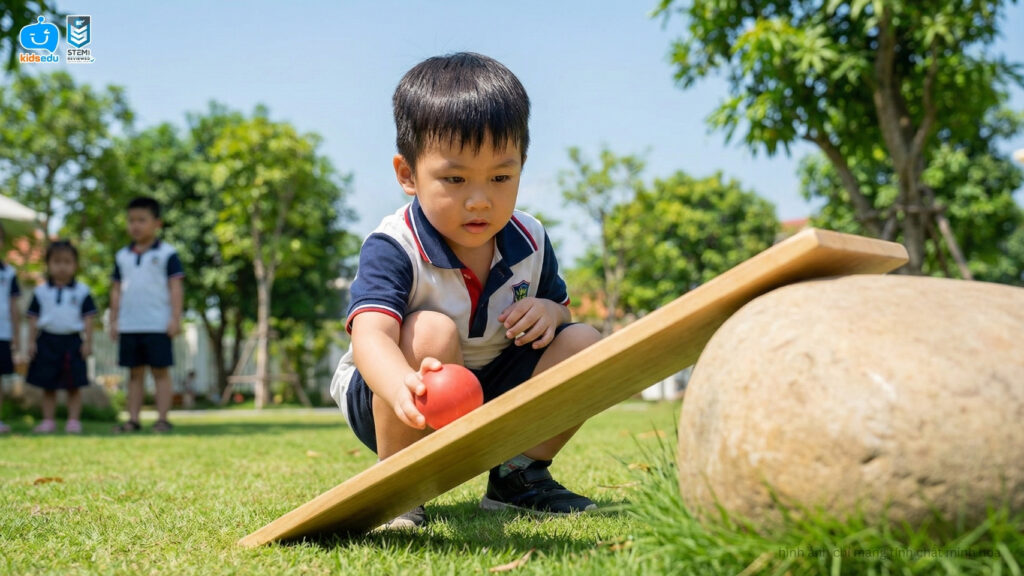
It is through physical exercise that the brain’s hippocampus—the epicenter of learning and memory—ignites the production of new neurons. As Dr. John J. Ratey (Clinical Associate Professor of Psychiatry at Harvard Medical School) demonstrates in his groundbreaking book, Spark: The Revolutionary New Science of Exercise and the Brain, movement isn’t just for the body; it’s for the mind. KidsEdu STEM leverages these kinesthetic exercises to ensure children internalize spatial logic far more effectively than through traditional, static classroom methods.
2. Mastering Kinesthetic Math: Expert Strategies from KidsEdu
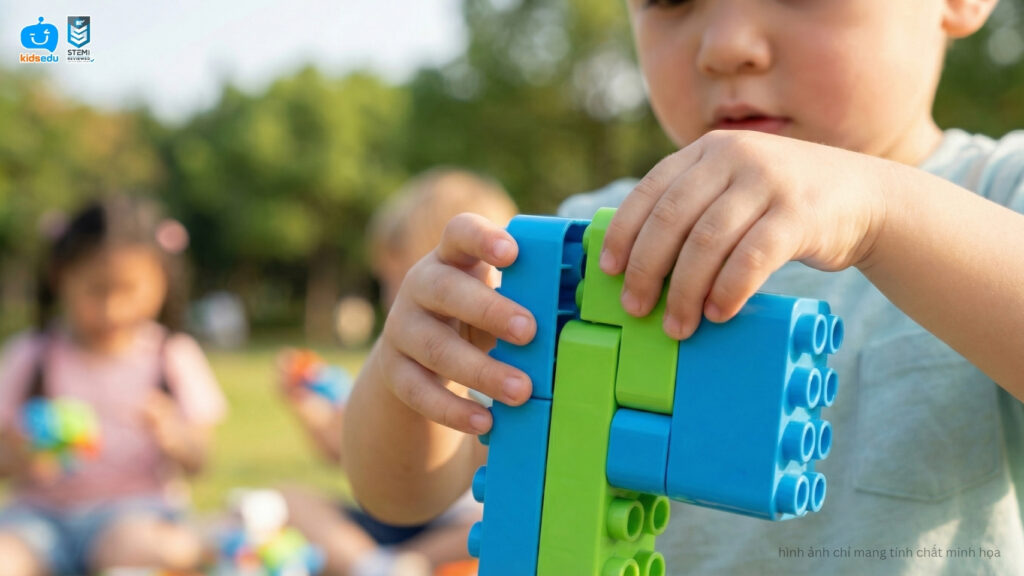
The golden rule for educators is to avoid “hand-holding.” Instead, we empower students by presenting “open-ended action problems,” allowing them to experiment, fail, and self-correct directly in the field.
2.1. The Spatial Logic Challenge: Building Equilibrium Towers
By providing children with natural elements of varying curves and lengths, we set a singular goal: to build the tallest stable tower. In this activity, children must constantly evaluate centers of gravity and engage in real-world physics experimentation.
2.2. The Teacher as an “Active Observer”
Drawing from Lev Vygotsky’s Constructivist Theory, the KidsEdu STEM curriculum positions the educator as a “scaffold.” Rather than providing answers, teachers intervene with strategic prompts: “Why do you think the tower collapsed that time?” or “What happens if you rotate this branch?” This approach safeguards the child’s cognitive autonomy, fostering robust, independent problem-solving skills.
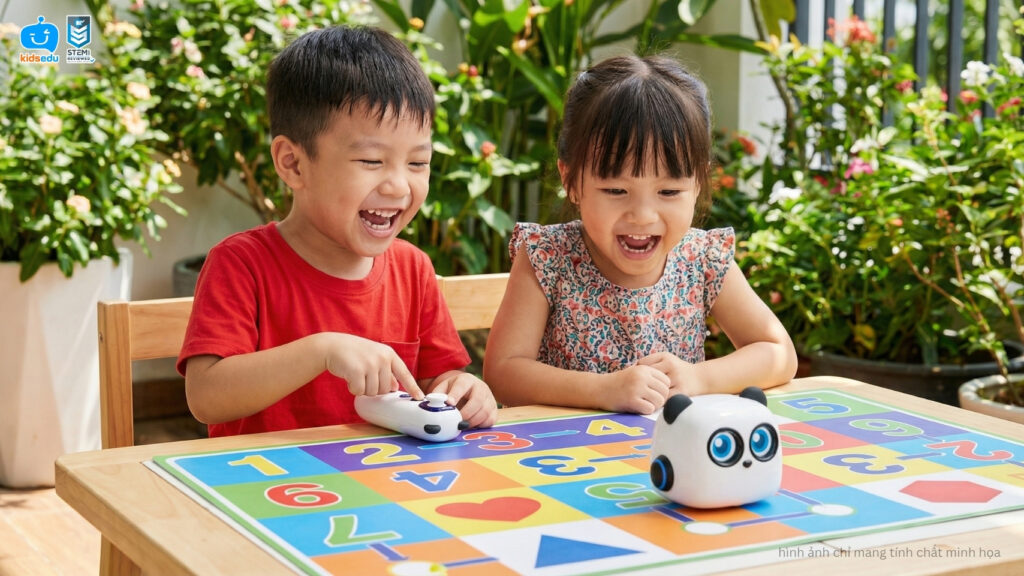
Outdoor mathematical engagement acts as the perfect bridge, seamlessly integrating with KidsEdu STEM’s high-tech Robotics and AR/VR Labs to cultivate a holistic developmental path from nature to Industry 4.0.
3. FAQ: Decoding Kinesthetic STEM Learning
Can 3-to-4-year-olds actually develop logical thinking through movement?
Absolutely. According to Early Childhood Education Frameworks, children in this age bracket thrive when learning logic through gross motor skills. Tasks such as identifying spatial positions (over/under, inside/out) or classifying objects during relay races are highly effective cognitive triggers.
[H4] What do preschools need to implement the KidsEdu STEM movement program?
Schools can simply leverage their existing playground space alongside the KidsEdu STEM Supplementary Curriculum. Contact us today to access detailed sample lesson scripts. 👉 [Access the KidsEdu Lesson Library Here]
